publications
2026
- Technical Report
 Qwen-UI-Agent Technical Report: Toward Next-Generation Real-World Centric Foundation GUI AgentsHanzhang Zhou*, Panrong Tong*, Xu Zhang* , and 24 more authorsarXiv preprint arXiv:2607.28227, 2026
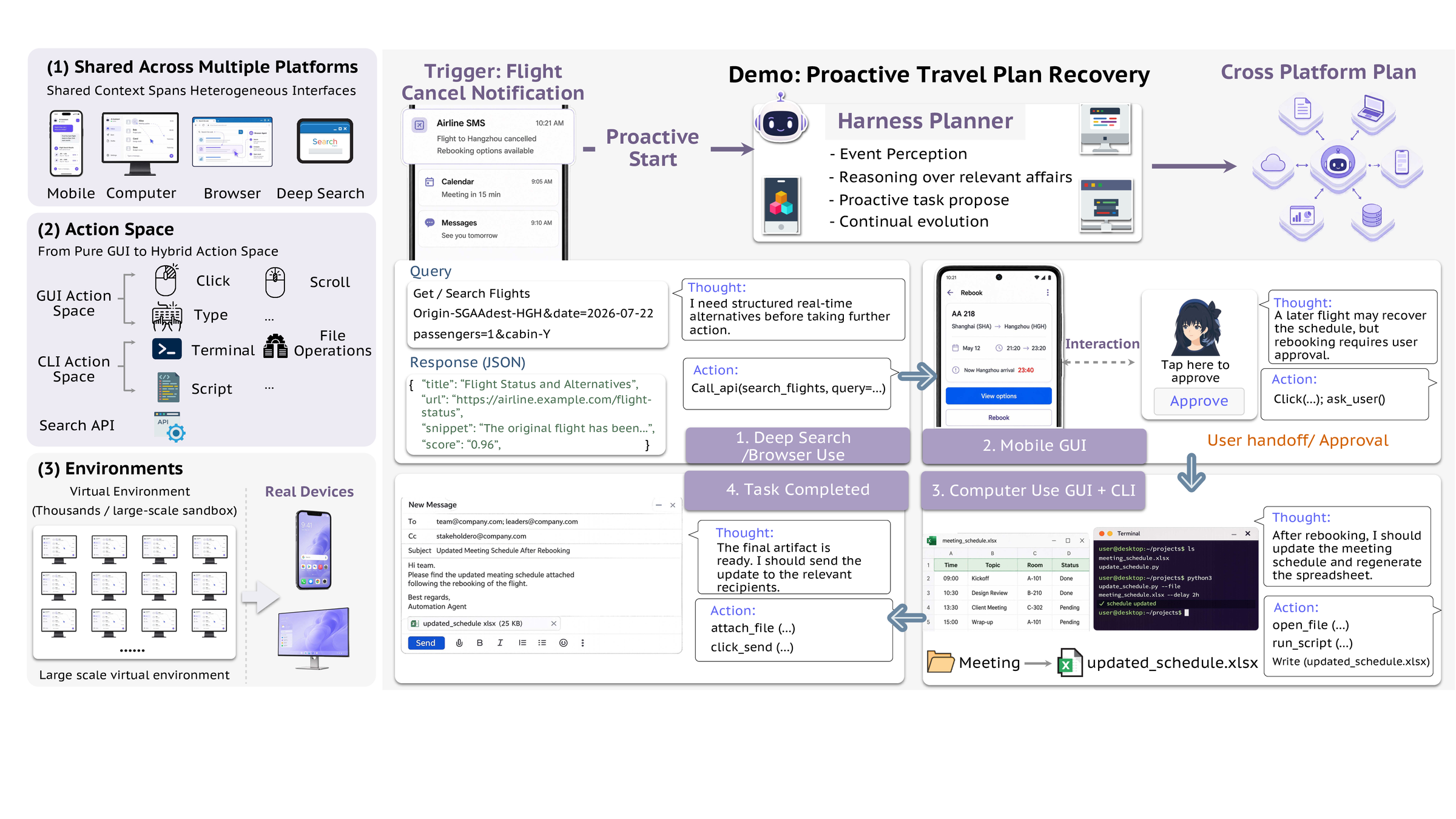
GUI agents have the potential to become a general purpose executor over existing digital devices. To advance them toward real-world use, we envision agents that operate reliably on real devices, execute workflows across platforms, combine GUI interaction with CLI execution, complete long-horizon tasks, proactively initiate useful services, and autonomously improve their capabilities with minimal human effort. Guided by this vision, we present Qwen-UI-Agent, a real-world centric foundation GUI agent spanning mobile, computer-use, web, and DeepSearch environments. Qwen-UI-Agent combines diverse sandbox environments with a large-scale real-device mobile runtime. Its unified action space interleaves GUI operations with CLI execution and generates batched actions in a single model turn. An AutoResearch-style data flywheel uses agents to construct tasks and environments, diagnose failures, and plan subsequent iterations. Online RL supports training on trajectories exceeding 100 turns, with over 10,000 concurrent environments accelerating rollout. A lightweight harness layer supports proactive service initiation and stateful workflows across mobile and computer. Across a broad suite of evaluations, Qwen-UI-Agent sets state-of-the-art performance on mobile-use benchmarks while delivering competitive performance on computer- and browser-use tasks against frontier models, including Opus 4.8, Gemini 3.1 Pro, and GPT-5.6 Sol. On mobile use, it achieves 82.1% on MobileWorld, 92.2% on MobileWorld-Real, and 97.5% on AndroidDaily. On computer use, it achieves 79.5% on OSWorld-Verified and a 40.0% partial-progress score on OSWorld-v2. On browser use and GUI grounding, it achieves 73.6% on WebArena and 81.5% on ScreenSpot-Pro, respectively.
- arXiv
 PEARL: Solver-in-the-Loop Interactive Optimization Modeling from Natural LanguageHongliang Lu*, Zhong Li*, Yuxuan Chen , and 3 more authorsarXiv preprint arXiv:2607.18256, 2026
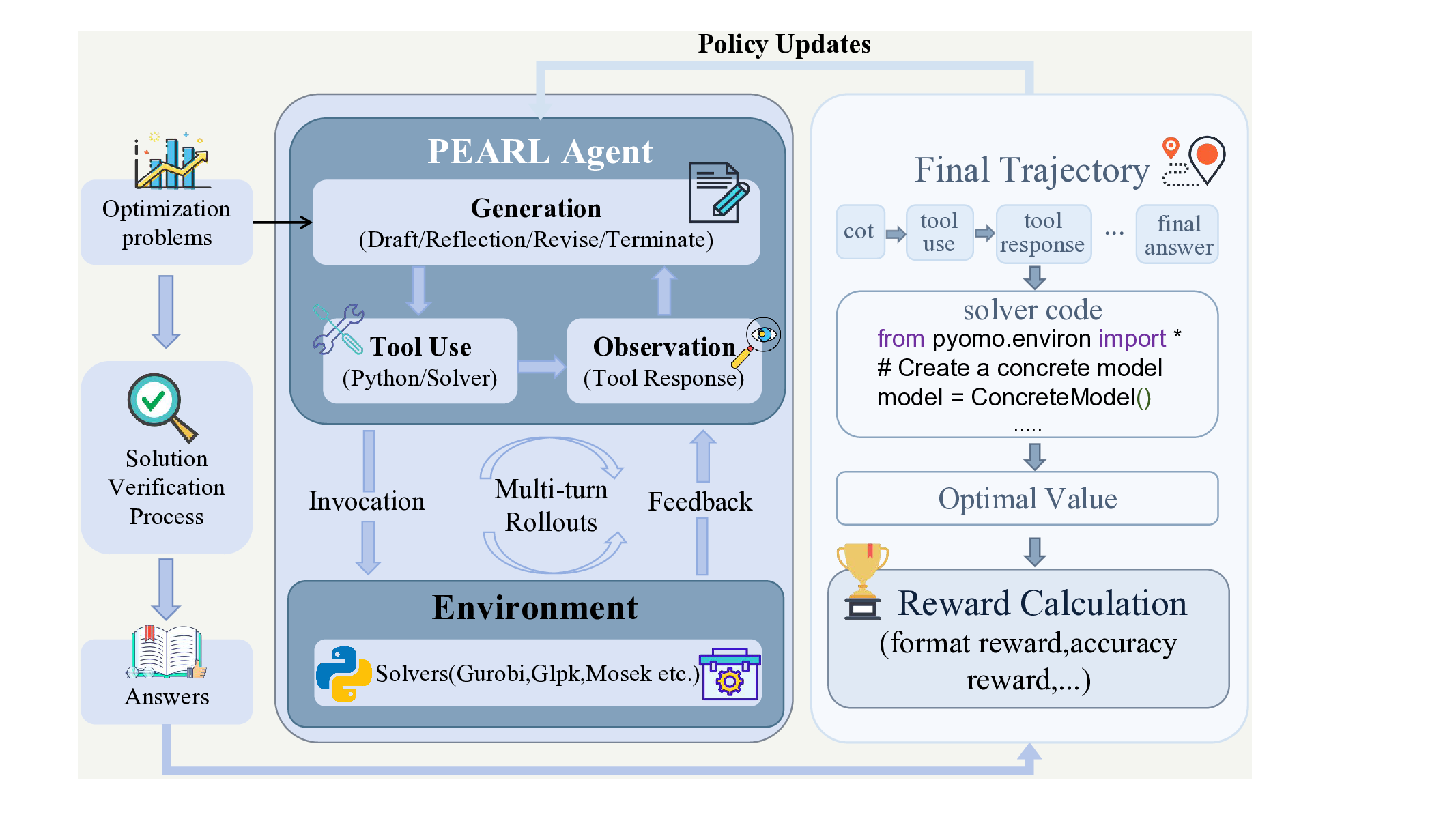
Optimization modeling is the process of translating real-world decision problems, often described in natural language, into formal mathematical formulations and executable solver code. While recent advances in large language models have shown promise in automating this process, most existing approaches remain one-shot: a model produces a formulation once, without executing it, conditioning on solver feedback, or iteratively revising errors. This stands in sharp contrast to real-world optimization modeling, which is inherently interactive and proceeds through repeated solve-debug-revise cycles. We introduce PEARL, a system for interactive optimization modeling that uses Python execution and mathematical programming solvers inside this loop. Rather than relying on a fixed repair workflow, PEARL learns when to test partial models, how to revise from solver diagnostics, and when to stop. It operates in a multi-turn tool-integrated setting where intermediate execution results, feasibility signals, and solution checks are used to improve both formulations and solver code before finalization. Across diverse optimization benchmarks, PEARL substantially improves verified solve rates over strong one-shot and tool-augmented baselines; notably, our PEARL-Qwen3-4B model outperforms the much larger DeepSeek-V3.2-685B in both macro- and micro-averaged accuracy on optimization modeling tasks.
- ICLR 2026
 Search Self-Play: Pushing the Frontier of Agent Capability without SupervisionHongliang Lu*, Yuhang Wen*, Pengyu Cheng , and 7 more authorsThe Fourteenth International Conference on Learning Representations, 2026
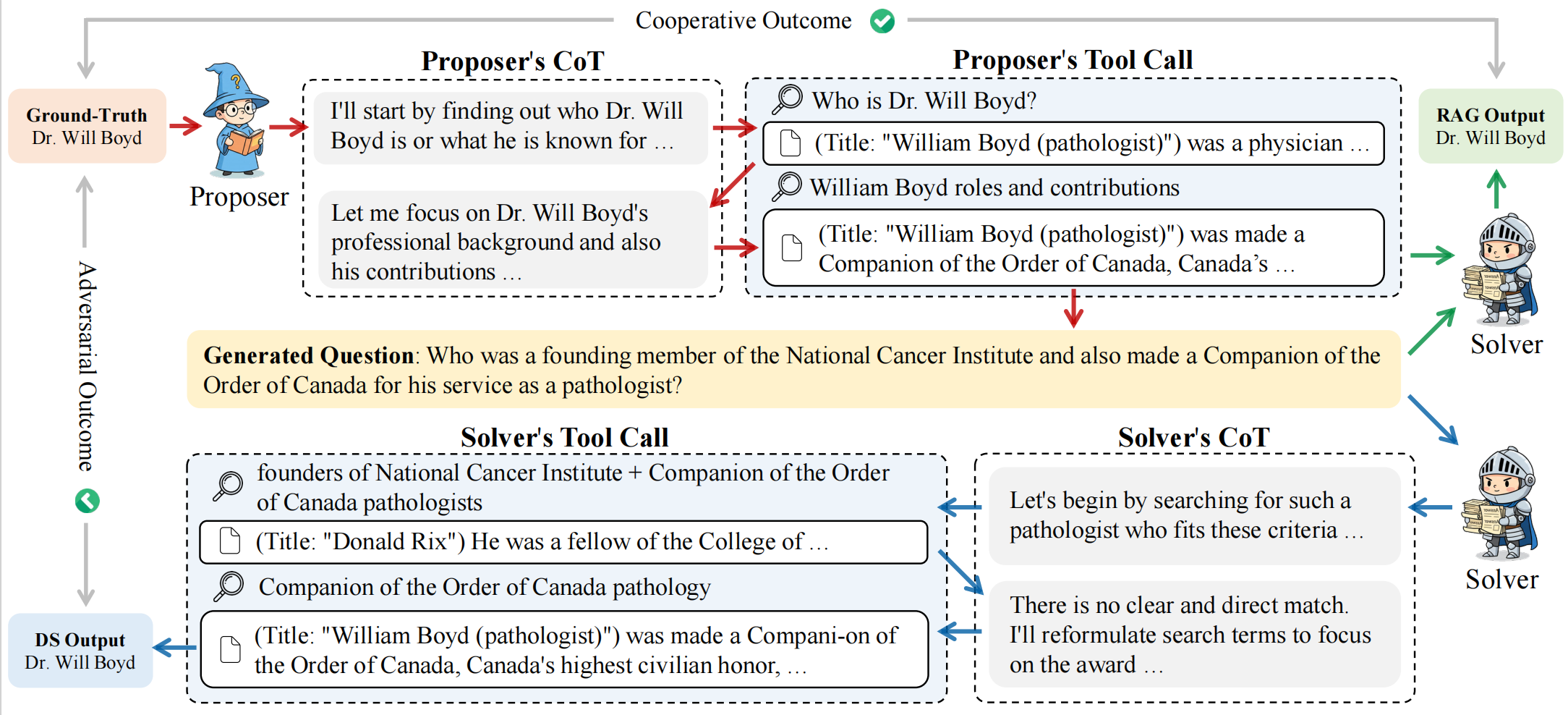
Reinforcement learning with verifiable rewards (RLVR) has become the mainstream technique for training LLM agents. However, RLVR highly depends on well-crafted task queries and corresponding groundtruth answers to provide accurate rewards, which requires massive human efforts and hinders the RL scaling processes, especially under agentic scenarios. Although a few recent works explore task synthesis methods, the difficulty of generated agentic tasks can hardly be controlled to provide effective RL training advantages. To achieve agentic RLVR with higher scalability, we explore self-play training for deep search agents, in which the learning LLM utilizes multi-turn search engine calling and acts simultaneously as both a task proposer and a problem solver. The task proposer aims to generate deep search queries with well-defined ground-truth answers and increasing task difficulty. The problem solver tries to handle the generated search queries and output the correct answer predictions. To ensure that each generated search query has accurate ground truth, we collect all the searching results from the proposer’s trajectory as external knowledge, then conduct retrieval-augmentation generation (RAG) to test whether the proposed query can be correctly answered with all necessary search documents provided. In this search self-play (SSP) game, the proposer and the solver co-evolve their agent capabilities through both competition and cooperation. With substantial experimental results, we find that SSP can significantly improve search agents’ performance uniformly on various benchmarks without any supervision under both from-scratch and continuous RL training setups.
- ICML 2026
 Constructing Industrial-Scale Optimization Modeling BenchmarkZhong Li*, Hongliang Lu*, Tao Wei* , and 5 more authorsForty-Second International Conference on Machine Learning, 2026
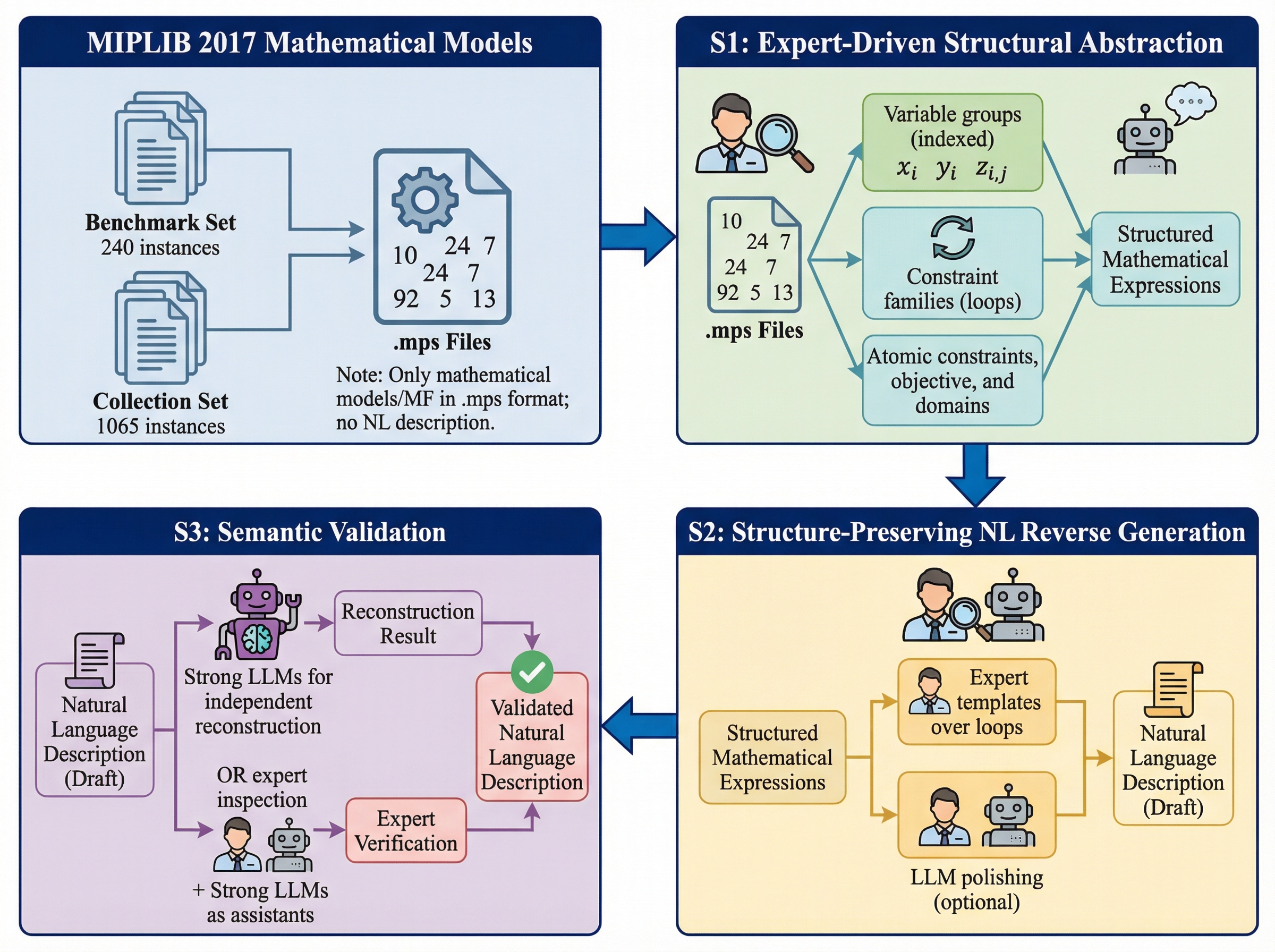
Optimization modeling underpins decision-making in logistics, manufacturing, energy, and finance, yet translating natural-language requirements into correct optimization formulations and solver-executable code remains labor-intensive. Although large language models (LLMs) have been explored for this task, evaluation is still dominated by toy-sized or synthetic benchmarks, masking the difficulty of industrial problems with 10^3–10^6 (or more) variables and constraints. A key bottleneck is the lack of benchmarks that align natural-language specifications with reference formulations/solver code grounded in real optimization models. To fill in this gap, we introduce MIPLIB-NL, built via a structure-aware reverse construction methodology from real mixed-integer linear programs in MIPLIB 2017. Our pipeline (i) recovers compact, reusable model structure from flat solver formulations, (ii) reverse-generates natural-language specifications explicitly tied to this recovered structure under a unified model–data separation format, and (iii) performs iterative semantic validation through expert review and human–LLM interaction with independent reconstruction checks. This yields 223 one-to-one reconstructions that preserve the mathematical content of the original instances while enabling realistic natural-language-to-optimization evaluation. Experiments show substantial performance degradation on MIPLIB-NL for systems that perform strongly on existing benchmarks, exposing failure modes invisible at toy scale.
2025
- ICML 2025
 OptMATH: A Scalable Bidirectional Data Synthesis Framework for Optimization ModelingHongliang Lu*, Zhonglin Xie*, Yaoyu Wu , and 3 more authorsForty-Second International Conference on Machine Learning, 2025
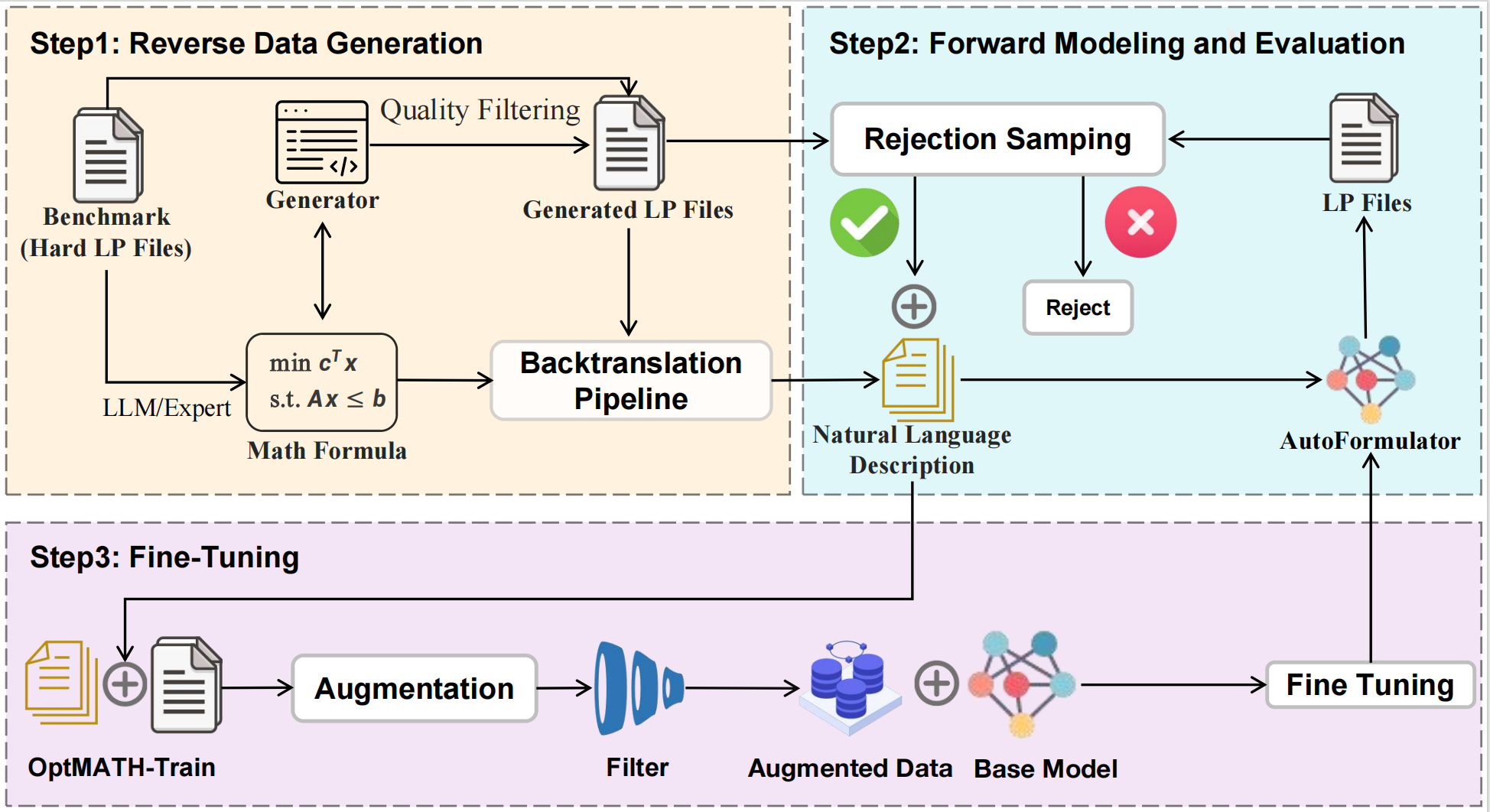
Despite the rapid development of large language models (LLMs), a fundamental challenge persists: the lack of high-quality optimization modeling datasets hampers LLMs’ robust modeling of practical optimization problems from natural language descriptions (NL). This data scarcity also contributes to the generalization difficulties experienced by learning-based methods. To address these challenges, we propose a scalable framework for synthesizing a high-quality dataset, named OptMATH. Starting from curated seed data with mathematical formulations (MF), this framework automatically generates problem data (PD) with controllable complexity. Then, a backtranslation step is employed to obtain NL. To verify the correspondence between the NL and the PD, a forward modeling step followed by rejection sampling is used. The accepted pairs constitute the training part of OptMATH. Then a collection of rejected pairs is identified and further filtered. This collection serves as a new benchmark for optimization modeling, containing difficult instances whose lengths are much longer than these of NL4OPT and MAMO. Through extensive experiments, we demonstrate that models of various sizes (0.5B-32B parameters) trained on OptMATH achieve superior results on multiple modeling benchmarks, thereby validating the effectiveness and scalability of our approach.